Guides
Budgeting Tips for College Students: Mastering Your Monthly Expenses
Master your monthly expenses with our essential budgeting tips for University of Alabama students. Learn to track costs, save money, and reduce financial stress.

Key takeaways
- Creating a budget starts with a clear understanding of your monthly income and all your expenses, including sneaky costs like textbook price spikes and utility overages.
- Combining budgeting frameworks, like using the 50/30/20 rule for big-picture allocation and a Zero-Based approach for daily accountability, creates a powerful system to manage your money.
- The University of Alabama offers free resources, like Peer Financial Coaching, to help students build a personalized budget and gain financial confidence.
- A cornerstone strategy for simplifying your budget is choosing housing with predictable costs, like the all-inclusive and furnished packages at Tenth & Tusk, which helps you avoid unexpected bills.
Let's be real: trying to balance an epic college experience at the University of Alabama with a limited budget can be stressful. You want to go to the game, grab food with friends, and make the most of your time here, but the reality of rent, tuition, and surprise costs is always lurking. This isn't just another list of generic "save money" clichés. This is your practical guide to getting control of your finances so you can spend less time stressing and more time enjoying college life.
This guide provides a step-by-step blueprint for creating a realistic budget that actually works for a UA student. We'll break down proven methods like the 50/30/20 rule and Zero-Based budgeting and point you to free local resources right here on campus that can help you succeed.
The First Step: Understanding Your Financial Landscape
Step 1: Tally Your Income
Before you can plan where your money is going, you need a clear picture of what’s coming in each month. Don't forget any sources, even if they feel small or inconsistent.
- Part-time jobs or on-campus work-study programs
- Financial aid disbursements from scholarships, grants, or student loans
- Money from your family
- Side hustles like tutoring, driving for a ride-share service, or freelance work
Step 2: Track Your Spending & Identify Costs
For one month, track every single dollar you spend. It might sound tedious, but it’s the only way to get a real, honest look at your habits. Use a simple spreadsheet, a notebook, or a budgeting app. As you track, categorize your spending into two buckets:
- Fixed Expenses: These are the costs that stay the same every month, like rent, tuition payments, car insurance, and streaming subscriptions.
- Variable Expenses: These costs change from month to month, such as groceries, dining out, gas, entertainment, and shopping.
Step 3: Unmask Hidden College Costs
Your budget can be easily derailed by expenses that pop up unexpectedly. Plan for these "hidden" costs so they don't catch you off guard. Check the official tuition and fees as a starting point, but remember to account for more.
- Academic: Textbooks, lab fees, online access codes for homework, and specific software for classes.
- Housing: Initial setup costs (like bedding and kitchen supplies), potential utility overages, and renter's insurance.
- Personal: Spontaneous social outings with friends, Uber rides, and emergency car repairs that always seem to happen at the worst time.
Choosing Your Budgeting Method: Finding What Works for You
The 50/30/20 Rule
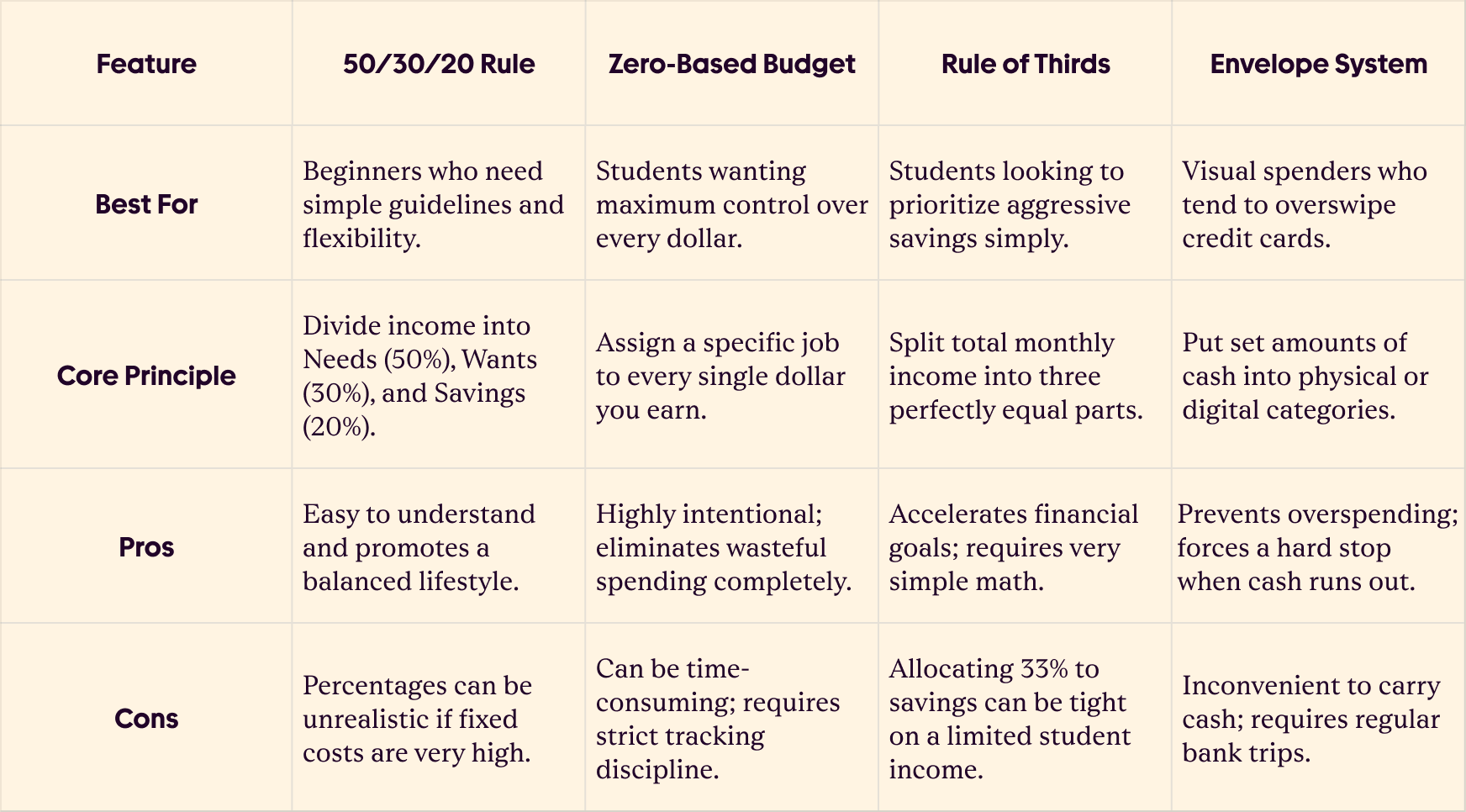
The 50/30/20 rule is built for high-level simplicity and flexibility. This framework suggests you divide your monthly take-home income into three distinct buckets:
- 50% for Needs: Crucial expenses you cannot skip, such as rent, tuition, groceries, and basic utilities.
- 30% for Wants: Lifestyle spending that makes college fun, including football tickets, dinners on the Strip, and morning coffee runs.
- 20% for Savings: Building an emergency fund, paying off student loans early, or investing for life after graduation.
This method is perfect for beginners because it provides clear guardrails without forcing you to log every nickel and dime.
Zero-Based Budgeting
If you find yourself constantly overspending your "wants" bucket, the Zero-Based Budget offers a more structured approach. The mathematical principle is straightforward: Income minus Expenses equals Zero.
Before the month begins, you give every single dollar a designated job. If you have $1,200 coming in, you distribute exactly $1,200 across your categories until nothing is left over. This does not mean your bank account hits zero; rather, it means savings goals, rent, and a late-night diner run each get an intentional allocation. This eliminates mindless spending because any extra money spent in one category must be manually taken from another.
The Envelope System
For students who struggle with swiping plastic too easily, the Envelope System introduces physical boundaries. You choose your most problematic variable spending categories (like dining out, groceries, and shopping) and allocate a set amount of cash for them at the start of the month.
That cash goes into labeled paper envelopes. Once the money in the "dining out" envelope is gone, you are done eating out until the next month. If you prefer a modern twist, many digital banking apps now offer "vaults" or "digital envelopes" that mimic this exact process on your smartphone.
Pay Yourself First
Also known as reverse budgeting, this method turns traditional budgeting on its head. Instead of focusing heavily on what you spend, you focus on what you save. The moment your monthly income hits your account, you immediately route a set amount (for example, $100) straight into your savings or emergency fund.
Once your savings goal is met and your fixed bills are covered, you are completely free to spend the remaining balance however you want without guilt. It is an excellent option for hands-off students who want a stress-free system.
The Ultimate Student Strategy: Creating a Hybrid System
For the ultimate student strategy, you do not have to pick just one framework. In fact, combining methods gives you the best of both worlds.
A popular hybrid approach is blending the 50/30/20 Rule with Zero-Based Budgeting. You use the 50/30/20 rule to map out your big-picture monthly targets. Once you know your total allowance for needs, wants, and savings, you apply the Zero-Based method to assign specific dollar amounts within those categories before the month begins.
Alternatively, if you find that your "wants" category consistently disappears too quickly, you can hybridize by using the Envelope System solely for your entertainment fund while letting the rest of your budget remain automated. This hybrid strategy gives you the flexible boundaries of a percentage-based lifestyle while maintaining strict, localized accountability where you need it most.
Comparing Your Budgeting Options
Putting Your Budget into Action at The University of Alabama
Leverage Free On-Campus Resources
You don't have to figure all this out by yourself. The University of Alabama has services designed to help you succeed financially. Take advantage of the UA's free Peer Financial Coaching program to get one-on-one advice from a trained peer who gets it. They can help you create a custom budgeting worksheet and build skills that will last a lifetime.
Smart Savings on Daily College Life
Small changes in your variable spending can make a huge impact on your budget.
- Food: Cooking at home more often and meal prepping for the week can save you hundreds. If you need help navigating your UA student meal plan, there are ways to optimize it.
- Social: Always ask about student discounts and show your student ID. Keep an eye out for free campus events like concerts, movie nights, and festivals.
- Textbooks: Before you buy from the bookstore, check for used copies online, rent digital versions, or see if an older edition is acceptable.
Simplify Your Budget with Predictable Housing Costs
Rent is almost always your biggest fixed expense, and surprise utility bills can wreck even the most well-planned budget. This is exactly where choosing the right off-campus housing becomes a powerful budgeting tool.
Tenth & Tusk premier Tuscaloosa student living explicitly designed to give you financial predictability. Our all-inclusive rent packages cover essential utilities like high-speed internet and water up to a generous cap, entirely eliminating the guesswork of monthly billing. Plus, with our fully furnished packages, you avoid the massive upfront cost of buying furniture or hiring movers. This built-in stability makes it so much easier to stick to your budget month to month.
Frequently Asked Questions about Student Budgeting
What is the best way to build my college budget?
Start by tracking your income and all expenses for one full month. Then, use a method like the 50/30/20 rule to set spending goals and a zero-based budget to assign every dollar a purpose. Utilize tools like a spreadsheet or a budgeting app to keep you on track.
What are the most common mistakes in budgeting?
Common mistakes include creating an unrealistic budget you can't stick to, forgetting to plan for unexpected expenses (like car repairs), not tracking small purchases that add up, and giving up after one bad week.
How much money should I have saved for an emergency fund?
While the standard advice is 3-6 months of living expenses, this is often unrealistic for a college student. A great starting goal is to save $500 to $1,000 in a separate savings account. This can cover a flat tire, an unexpected medical co-pay, or a last-minute flight home without creating financial stress.
How can I save money on school supplies and textbooks?
Always compare prices online before buying from the campus bookstore. Look for used books, rent digital or physical copies, and ask your professor if an older, cheaper edition of the textbook is acceptable for the course.
Where can I find a template to track my college budget?
You can download a printable Rental Budget Worksheet directly from the UA Off-Campus Resources website. This student-focused checklist lets you balance your semester financial aid refunds against school bills, local Tuscaloosa utilities, and personal spending habits. If you prefer a digital option that performs the math automatically, you can open Google Sheets or Microsoft Excel (free with your student account) and select a pre-made budget layout from their template galleries.
Take Control of Your Finances for a Better College Experience
Mastering your budget is about more than just numbers; it's about empowerment. Tracking your money, choosing a method that fits your life, using free campus resources, and simplifying your housing costs are the keys to reducing financial stress.
Budgeting isn't about restriction. It's the tool that gives you the freedom to fully enjoy your time at the University of Alabama. By making a smart housing choice at a community like Tenth & Tusk, you build a stable financial foundation, allowing you to focus on what really matters: your studies, your friends, and your college experience.
related stories

Guides
UA Meal Plans & On-Campus Dining: A Student Guide
Navigating Bama meal plans? Our student guide breaks down the University of Alabama's on-campus dining options, costs, and plans to help you choose the perfect fit for your lifestyle.

Guides
Moving Tips for Bama Students: Moving into Tenth & Tusk
Make your Bama move-in a breeze with our top moving tips for college students. Learn what to pack, how to save space, and why Tenth & Tusk is the best choice.

Reviews
Roll Tide, New Vibe: Premier Student Living at Tenth & Tusk
Discover the new era of premier student living at Tenth & Tusk. Explore fully renovated apartments, a luxury recovery spa, and an unmatched vibe.
Be the first to experience the new standard in tuscaloosa student living.
all new apartments Now leasing
Get Insider Access